
Every year in Spain there are about 40,000 cardiac arrests: one every 13 minutes on average. The survival rate of patients suffering from this type of illness is 11 %%: only 1 in 5 cases receive resuscitation maneuvers, and only 6% % of the population know how to perform cardiopulmonary resuscitation (CPR).
This high mortality rate can be reduced if a series of important actions are taken, all of which constitute what is called the Survival Chain:
1. Early recognition of symptoms and early activation of the Prehospital Emergency System
2. Rapid and appropriate initiation of Basic Life Support (BLS) techniques
3. Early defibrillation
4. Rapid and appropriate initiation of Advanced Life Support (SVA) techniques and post-resuscitation care
Despite the fact that an SVB and premature defibrillation have been performed, if the SVA techniques and post-resuscitation care are delayed or inadequate, the “Chain of Survival” breaks down.
The SVA includes: Basic Life Support, the use of advanced equipment and special techniques to establish and maintain effective ventilation and circulation, ECG monitoring, 12-lead ECG interpretation, recognition and interpretation of arrhythmias, establishment and maintenance of vascular access, treatment of patients with respiratory and/or cardiac arrest, including the post-resuscitation stabilization phase, treatment of patients with suspected Acute Coronary Syndrome, and finally strategies for the rapid assessment and fibrinolytic treatment, if indicated, in patients with ischemic stroke.
GENERAL OBJECTIVE
The basic objective of the SVA courses is the dissemination of the theoretical background and the practical skills that constitute it among the medical and nursing staff, with the aim of preventing and treating cardiopulmonary arrest (CPR).
METHODOLOGY
1st PHASE NO PRESENTIAL: 12 hours
It is carried out online through the platform enabled by the Catalan Council for Resuscitation (CCR). The student must enroll individually in the course, after receiving the appropriate instructions from the IEM, and follow the activities marked by the course consultants, taking into account the established deadlines. The online phase includes a theoretical assessment; the submission and completion of all online activities is essential to be able to take the face-to-face phase of the course.
2nd PHASE IN PERSON: 12 hours, divided into 3 sessions of 4 hours
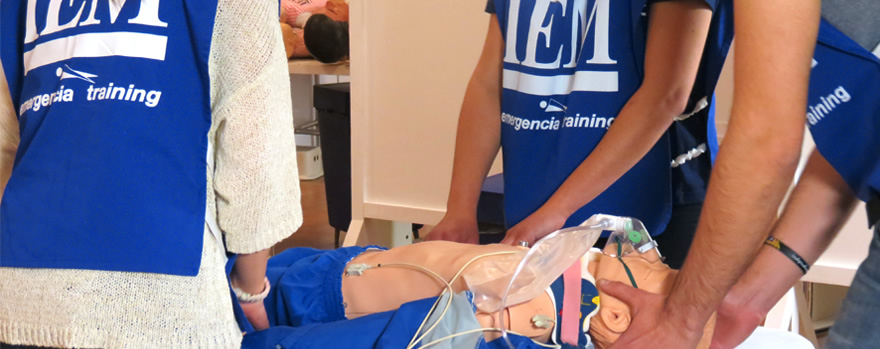
This phase includes 2 theoretical assessments, a practical assessment, theoretical classes, and practical stations.
ASSESSMENT AND CERTIFICATION
It is mandatory to attend 100% % of the course. Students must successfully pass the theoretical assessments (a 70% % correct answer rate is required) and all the practical assessments.
Students who successfully complete the course will receive:
Official certificate issued by the Catalan Council of Resuscitation (CCR) recognized by the Spanish Council of CPR according to the 2015 guidelines of the European Resuscitation Council (ERC).
This certificate includes credits from the Catalan Council for Continuing Education in the Health Professions.*
*The granting of credits for training activities accredited by the CCR depends directly on this body.
Programme
• Recognition of the critical patient
• ABCDE methodology
• Prevention of cardiorespiratory arrest
• Recognition of the PCR
• Learning non-technical skills: teamwork, leadership, decision-making
• Resuscitation in a health center or area
• High-quality cardiopulmonary resuscitation
• Advanced Life Support Algorithm
• Management of the airway and ventilation
• Arrhythmias. Monitoring and recognition
• Defibrillation and cardioversion
• Routes of drug administration
• Medications
• Post-resuscitation care
Image gallery
Course details
Price
300 €
Available places
8
Course duration
12 hours online
12 hours in person
Upcoming editions
Course registration
To enrol on the course, select the course edition and follow the process on the edition page.
If you cannot find an edition and you are interested in taking it, please contact us.